Commentary
Addressing the myopia pandemic
December 11, 2025
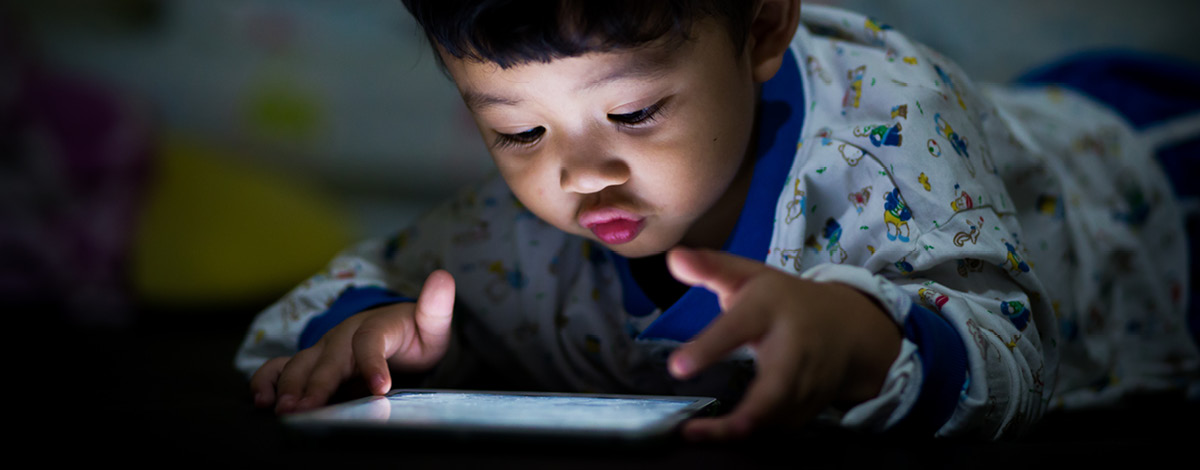
Of the five senses, vision is regarded as the most important as it allows us to navigate our environment, recognize the faces of our loved ones and read and watch to learn and entertain. But a good number of us do not have healthy eyes. According to the World Health Organization (WHO), at least 2.2 billion people globally suffer from near or distant vision impairment. The organization recognizes myopia as a significant public health concern given its rising prevalence around the world. A review of 276 studies (involving more than 5.4 million children from 50 countries across six continents) by the British Journal of Ophthalmology revealed that global prevalence of myopia among children and adolescents increased from 24% in 1990 to 36% in 2023 – one in three of all children and teens are nearsighted today. What is even more concerning is that myopia is starting earlier in children than before.
Prevalence of myopia by age group in 2000 vs. 2050, % of world population
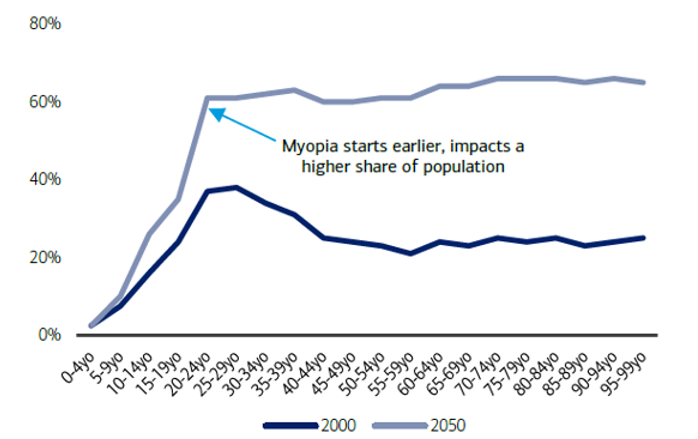
Source: American Academy of Ophthalmology, BofA Global Research
The study predicted that approximately 740 million children and teens (more than half globally) will be myopic by 2050. American Academy of Ophthalmology in its 2016 article forecasted that by 2050, myopia would affect nearly half of global population. A more conservative projection this year puts the number at ~40% of global population – but it is clear that the world 25 years from now will have more than the 2.2 billion people in need of corrective lenses today.
Prevalence of myopia is not even across the world. Asia sees a higher prevalence (close to 40%) that is two to four times higher than that of other regions. East Asian countries – China, Taiwan, South Korea, Japan and Singapore – see much higher myopia rates, exceeding 80–90%, in their adolescent populations.
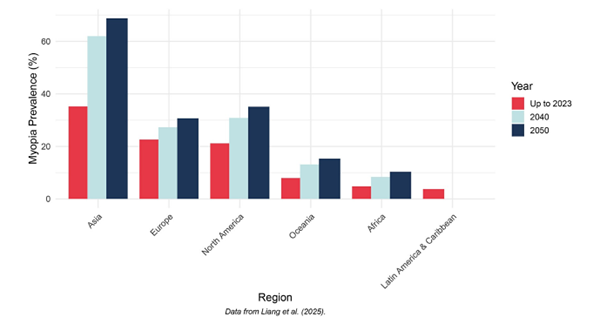
Source: ScienceDirect, Global perspectives on myopia and pathologic myopia: From environmental drivers to precision medicine
Primary drivers of myopia are genetics, near-work activities and lack of outdoor activities. A recent article in Progress in Retinal and Eye Research journal linked the high prevalences in the East Asian countries to educational systems characterized by intense academic competition, prolonged school hours and substantial homework assignments which significantly reduce opportunities for outdoor activities.
The WHO estimated that vision impairment cost the global economy an estimated USD411 billion in productivity loss, with only 36% of people with myopia having access to an appropriate intervention. Shanghai Conant Optical Co. Ltd. (2276 HK) in our Emerging Markets Small Cap Strategy seeks to address this global myopia pandemic. SCO, a sub-USD3 billion market cap company, is the second largest resin (plastic) optical lens maker in the world after EssilorLuxottica in terms of production volume. At its manufacturing locations across China and Japan, the company produced 209 million pieces to serve customers in over 90 countries around the world in 2024.
We believe SCO’s customer value proposition of value for money is especially effective in the product category of optical lenses. SCO’s high-index lenses (such as 1.74 and 1.67) are approximately half the price of comparable lenses from EssilorLuxottica, Hoya and Zeiss whilst providing the same level of vision correction. On product quality, SCO is an ODM (original design manufacturer) for all the previously mentioned global brands with various lens-coating options available. For the brand-conscious, it is “fortunately” very difficult to tell which brand of lens one is wearing. We are not surprised that the company is especially seeing strong demand in developing countries where its customer value proposition would be stronger. As a person who has been wearing glasses for the past three decades, I have found myself switching from the expensive Hoya and Nikon to much more affordable brands (including Asahi-Lite which is now owned by SCO), which have provided an identical visual experience – I have not looked back since.
China offers a significant room for growth, having entered the world’s largest short-sighted country in 2018, two decades after the company was established. Over 700 million people or roughly half the population in China are diagnosed with myopia. The prevalence of myopia is especially high in school-aged children – roughly 40%/70%/80% of students in elementary/middle/high school suffered from myopia according to a 2022 study published in Investigative Ophthalmology & Visual Science. Laser eye surgery is not an option for these youths, and they must rely on glasses for vision correction until they are older. SCO’s sales in China focus on higher-index lenses where competition is more limited and penetration is lower, and 80% of those sales are of its own brand. The company’s growth in China has been margin accretive given the higher mix of own brand and higher-index lenses.
The company is also involved in the development of AI/AR glasses with leading technology companies in North America and China. SCO as a partner to the technology companies makes sense, given SCO’s scale and cost competitiveness. We appreciate that SCO is trying to solve the problem of the global myopia pandemic, but do not doubt that AI/AR glasses offer the next leg of growth for the company.